 +377 6 80 86 40 50



F1 Drivers See the World Differently | Monaco Grand Prix Hospitality Guide

F1 Drivers See the World Differently
Monaco Proves It, and Science Explains Why
From TV, Formula 1 looks like a spectacle of speed, noise and scenery. Monaco adds a postcard on top of it: yachts, harbour, luxury hotels and famous corners carved into a tiny city. But from the cockpit, Monaco is something very different. It is not a postcard. It is a narrow, violent, ultra-structured visual problem that the human brain is barely supposed to handle — and yet F1 drivers solve it 78 times in a row.
When fans hear Lewis Hamilton warning his team about incoming rain, or George Russell laughing that he may have mistaken sweat for raindrops, or another driver calmly analysing a rival’s grip while racing at 280 km/h, it sounds almost superhuman. Monaco is where this difference between “normal vision” and “F1 driver vision” becomes most obvious.
This article explains why F1 drivers see the world differently, how Monaco exposes that difference, and how modern science — from cognitive psychology to AI research — helps us understand what is really happening inside the helmet.
1. Monaco: A Circuit That Breaks Normal Vision
Most race circuits are wide, open and visually forgiving. You can see the next corner early, you have large run-off areas, and the horizon is almost always visible. Monaco is the opposite. It behaves like a visual stress-test for the human brain:
- Zero forgiveness: barriers instead of run-offs, walls only a few centimetres from the tyres.
- Compressed sightlines: corners appear late and disappear quickly between buildings.
- Constant light changes: from bright harbour sun to tunnel darkness to heavy shadows from trees and apartments.
- Urban clutter: balconies, banners, fences, LED panels, sponsor logos and camera flashes everywhere.
A normal driver thrown into an F1 car at Monaco would experience something close to sensory overload. The brain would treat most of this as noise. An F1 driver, however, turns this chaos into a narrow, usable data stream.
2. What an F1 Driver Actually Sees (It’s Not What You Think)
Fans imagine that drivers enjoy the best view in the house: the sea, the harbour, the luxury hotels, the full shape of every corner. In reality, the cockpit view is brutally limited.
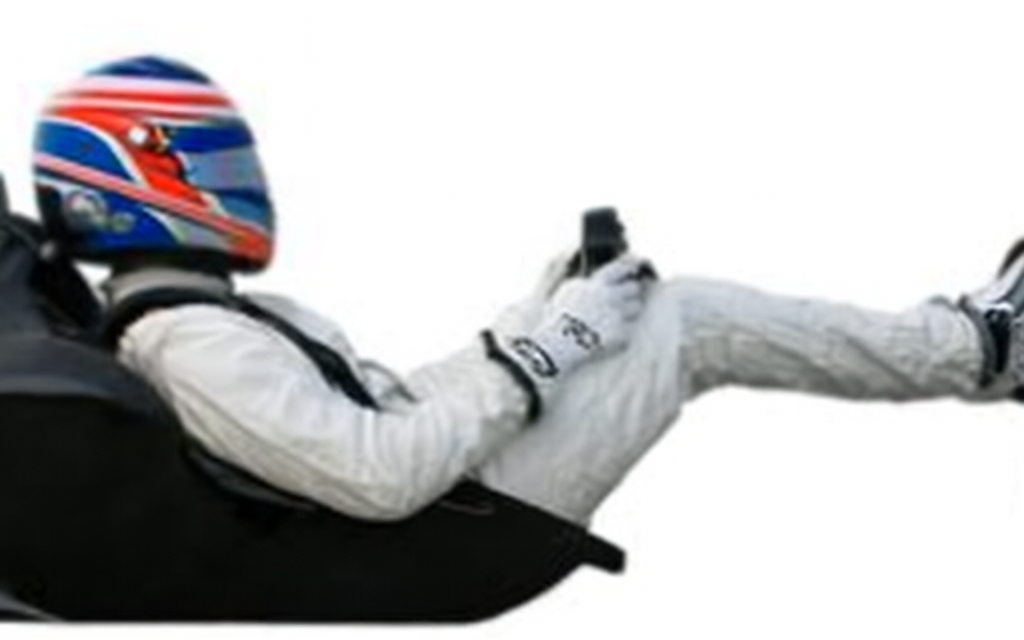
The driver sits extremely low, with legs stretched forward and the eyes just above the edge of the cockpit. The halo and the visor frame the world into a thin horizontal slit. At Monaco, this slit is filled almost entirely with asphalt and walls.
In practice, a driver’s visual world at Monaco is reduced to:
- A narrow forward corridor: a 1–2 second window of tarmac, kerbs and walls directly ahead.
- Minimal landmarks: brake boards, painted lines, kerb shapes, the way a barrier curves.
- Peripheral blur: terraces, yachts, buildings and even grandstands are mostly patches of colour and motion in the edges of vision.
- Instrument layer: inside the cockpit, LED lights for revs, a gear number, a few characters of text (“BOX”, “+0.2”, “MODE”), and sometimes a coloured bar for battery or fuel modes.
F1 drivers do not see Monaco as a scenic postcard. They see a moving puzzle: where is the next apex, how close is the wall, how much space do I have on exit, where does the track fall away or compress?
3. Monaco Corner by Corner: The Visual Tunnel
Sainte-Dévote: Chaos Through a Keyhole
At the start, drivers launch towards Sainte-Dévote and see almost nothing beyond the back of the car in front. The track narrows, the trees cast heavy shadows, and the braking markers arrive fast. On the right, a concrete wall; on the left, grandstands and terraces forming a vertical wall of people.
Fans on a high terrace or in the main grandstand can read the whole picture: who moves left, who gets squeezed, who dives inside. The driver does not “see” the race like that. He reads only gaps and angles: which car is moving where and whether there is a hole that will still exist half a second later.
Beau Rivage and Massenet: Losing the Horizon
As the car climbs Beau Rivage, the horizon compresses and disappears. The driver’s field of view becomes mostly tarmac and barriers. Terraces and apartment balconies cross the top of the vision as a moving band of shadow and light.
At Massenet, the car is already loaded with lateral force. The eyes flick forward to the barrier shape and then to the next reference point: a building edge, a patch of darker asphalt, the direction of the Armco line on exit. The brain does not care about the casino architecture; it cares about curvature.
Casino to Mirabeau and Hairpin: The Only “Slow-Motion” Zone
From Casino down to Mirabeau, speed is still high, but the view briefly opens and the driver can see further ahead. Once the car reaches the Grand Hotel Hairpin, it enters the one part of Monaco where the brain finally has time to breathe.
At walking speed, the driver can actually pick out individual faces on balconies, phones filming, and people leaning over fences. Ironically, what looks narrow and impossible on TV feels visually “wide” compared with the high-speed sections. The hairpin is more about steering lock and patience than pure visual overload.
Portier and the Tunnel: From Sunlight to Abstraction
Portier gives the last clear view of the harbour area. The driver sees bright light, glittering water on one side and heavy shadows on the exit wall. Then the car dives into the tunnel.
Inside, the entire world is reduced to a darker corridor with a bright rectangle at the end. Sound amplifies against the walls, and the steering feels slightly lighter as the car accelerates downhill. The brain keeps one task in focus: hold the line, aim for the patch of light, prepare to brake the instant the tunnel spits you out.
Nouvelle Chicane, Tabac and Swimming Pool: Vision at the Limit
Out of the tunnel, the driver is hit by light, colours and motion all at once: yachts in front, grandstands to the right, a tight chicane framed by barriers and kerbs. Eyes lock onto the braking board, then the first apex, then the second apex. Everything else becomes background noise.
Tabac and the Swimming Pool complex are where the human visual system is closest to its limit. The car changes direction violently, walls rush past within centimetres, and yet the driver must still pick out exact apex points on the kerbs. Grandstand K, the harbour and the terraces provide a spectacular picture for fans, but to the driver they are only a vibrating frame around the tunnel of useful information.
4. The Cognitive Stack: What Drivers Process in One Lap
Monaco proves something fundamental: the difference between a normal driver and an F1 driver is not just reaction time or bravery. It is how their brain structures information. Instead of one stream of “what I see”, an elite driver seems to run several layers in parallel — a cognitive stack.
At any moment, a driver can be processing:
- Vehicle control: steering angle, throttle modulation, brake pressure, when to rotate the car, where to place the wheels relative to the wall.
- Grip mapping: which corners have less traction, where the rear steps out, where new rubber creates more bite, how tyres are evolving lap by lap.
- Rival behaviour: who is aggressive on exit, who is braking early, who is missing apexes, where a move might be possible three or four laps later.
- Race layer: gap to cars ahead and behind, target lap times, fuel saving, tyre saving, Safety Car windows, pit stop windows.
- Environment: clouds building over one sector, changing light levels, first signs of rain on the visor or camera lens, debris on track.
The spectacular part is that many of these layers are not conscious in the way most people experience attention. Pure car control is largely automatized; it lives in muscle memory and predictive models the brain has built over thousands of laps in simulators and on track. That frees mental bandwidth to watch rivals, read the sky and think strategically.
5. The Stories Fans Love: Meteorologists, Stewards and Comedians
This extra bandwidth is why some of the most iconic F1 radio moments feel almost unbelievable.
Lewis Hamilton has a long history of acting like an in-car meteorologist. He will warn his team that “rain is coming at Turn 2” or that “it’s much wetter on the back straight” while still pushing near qualifying pace. From the outside, it sounds like magic. From the inside, it is the result of a brain that constantly tracks clouds, light reflections on the track and the feel of the tyres.
George Russell, meanwhile, became famous for a different kind of weather call. In one race, he reported rain at a specific corner, only to later suspect that the “raindrops” were actually sweat inside his helmet. The moment was hilarious for fans, but it also revealed something interesting: drivers are so tuned to micro-sensations on their skin and visor that they will immediately report any change that might affect grip or strategy.
Then there are the drivers who play “steward” or “race engineer” in real time — calling out that a rival went off-track twice, or that another car has “no grip in the last sector”. They are not just surviving Monaco. They are actively auditing the race while driving it.
To fans, these radio messages are entertainment: meteorology, humour, sarcasm, live analysis. To neuroscientists, they are evidence of an unusual level of cognitive spare capacity under stress.
6. The Science: How the Brain Turns Monaco Into a Predictive Model
How is this possible? Modern cognitive science offers several useful concepts to explain why F1 drivers see the world differently.
6.1. Selective Attention and Feature Extraction
The human brain cannot process all visual input in detail. Instead, it selects and compresses. Over years of training, drivers learn which features matter: the exact edge of a kerb, the way a wall recedes, the brightness of a braking board, the subtle change in colour where the track is rubbered in.
Everything else — thousands of faces, banners, windows, boats, sponsor logos — is downgraded to a low-priority background layer. The driver’s perception is not richer than that of a fan; it is more aggressively filtered.
6.2. Predictive Processing and “Driving Into the Future”
Brains do not only react; they predict. In a modern theory called predictive processing, the brain is understood as a sort of internal simulator: it constantly predicts what will happen next and then compares that prediction with incoming sensory data.
An F1 driver at Monaco is almost literally “driving into the future”. The brain holds a detailed model of the lap: where the bumps are, how the car will behave, where the light changes, where the rear might step out. Vision is used not just to see the present, but to correct and refine this mental model hundreds of times per second.
6.3. Flow State and Cognitive Load
Elite athletes regularly enter what psychologists call a flow state: a mental condition in which performance is high, actions feel almost automatic and time perception is altered. Monaco, paradoxically, is where this state might be most necessary — and most fragile.
In flow, the driver does not feel like he is consciously juggling dozens of tasks. The layers of the cognitive stack slide into alignment. Car control becomes effortless, attention widens just enough to include rival behaviour and weather cues, and radio messages are integrated smoothly without disturbing the core activity.
7. Why Even AI Struggles to Match What Drivers Do in Monaco
At first glance, Monaco looks like a problem that AI should be good at: predictable layout, repeated laps, precise measurements available. In practice, it exposes several of the current limitations of AI and autonomous driving systems.
- Edge cases everywhere: reflections from windows, shadows from trees, patches of moisture, marbles off-line, unexpected debris — Monaco is full of visual and grip anomalies that are hard to model exhaustively.
- Insane cost of failure: a few centimetres too wide is not just a small error; it is a broken suspension and a destroyed race.
- Limited sensor horizon: like humans, an AI system on a car in Monaco cannot see far ahead. Many cues are local and appear late.
- Need for anticipation, not just reaction: reading rivals, predicting their choices, and anticipating weather or grip changes based on subtle cues is still an open challenge for machine systems.
Today’s AI can outperform humans in controlled simulation, in strategy modelling and in analysis of thousands of past laps. But it does not yet replicate the full package of human perception, prediction and adaptability inside a live race at Monaco — especially when the environment changes unexpectedly.
In other words: AI can help explain how drivers do it, but it cannot fully replace what they do there. Not yet.
8. Radio Messages: Multitasking Without Crashing the Brain
One question many fans ask is simple: how can a driver talk on the radio without losing focus?
The answer lies in timing and priority. Teams usually send messages on parts of the lap where the workload is slightly lower — on straights, in slower sections, or under Safety Car. Messages are kept short: a few words, a code, a number.
For the driver, replying is often delayed. He may hear “Mode strat six” or “Rain expected in five minutes”, finish a corner sequence, then answer “Copy” one or two seconds later when a small cognitive window opens.
Because core car control is automatized, this kind of micro-interruption does not necessarily crash the mental system. Instead, it is more like a quick software update applied on the fly.
9. What This Means for Fans Watching From Monaco
If you watch the Monaco Grand Prix from a terrace, a yacht or Grandstand K, you are not seeing the same race as the driver. You have a wider, more scenic view: the sea, the skyline, the complete arc of each corner, the flow of the cars as a group.
The driver lives inside a different reality. For him, Monaco is a narrow moving tunnel of asphalt, light, shadows, vibrations and constantly shifting probabilities. He feels the crowd as sound and colour more than as individual people; he senses the sea more through humidity and wind than as a view.
That contrast is part of what makes Monaco special. It is not just glamorous. It is the place where the limits of human perception are tested in public, where fans watch brains operating near the edge of what vision and cognition can do — and occasionally send a joke over the radio while doing it.
10. Conclusion: Monaco as a Window Into a Different Kind of Vision
F1 drivers do not have different eyes from the rest of us. But through years of extreme training and adaptation, their brains have learned to use vision in a different way. Monaco is the clearest proof.
On these tight streets, a normal person would see chaos, clutter and danger. An F1 driver sees a structured problem: reference points, grip zones, risk zones, timing windows. While fans enjoy Hamilton’s weather reports, Russell’s rain jokes or a rival’s live analysis of someone else’s lack of grip, science sees something deeper — a rare combination of predictive modelling, selective attention and flow state under extreme stress.
As AI systems get better, they will help us understand this superhuman-looking performance even more. But for now, Monaco remains the ultimate human demonstration: proof that the brain can turn a violent, narrow, visually overwhelming environment into a controlled, predictable and sometimes even humorous dance at 300 km/h.
